


The digital marketing landscape for international schools in Egypt has reached an fascinating crossroads. On one side, we have the explosive capability of generative AI tools that can conjure hyper-realistic images of smiling, diverse students studying in sun-drenched, futuristic libraries in a matter of seconds. On the other side, we have the discerning, highly critical eye of the modern Egyptian parent who is preparing to invest hundreds of thousands of pounds into their child's education.
For school directors and admissions teams in New Cairo, Sheikh Zayed, and Alexandria, a critical question has emerged: Should we use AI to generate our marketing visuals, or must we continue investing in professional school photography?
The answer is not a binary choice. It is a strategic synthesis.
As a visual strategist who actively utilizes both cutting-edge AI generation and high-end architectural and portrait photography, I have seen firsthand where each medium triumphs and where it fails disastrously. To win in today's saturated educational market, schools must understand that AI is a tool for concept and design, while authentic photography is the irreplaceable engine of institutional trust.
The Crisis of the "Uncanny Valley" in Education
Let us address the most pressing danger first.
Many schools attempt to cut corners by replacing their annual campus photoshoot with AI-generated imagery. They prompt an AI to create images of "happy students in a British international school in Cairo." The resulting images often look spectacular at first glance—perfect lighting, immaculate uniforms, and pristine focus.
But education marketing is high-stakes. Parents do not just glance; they scrutinize.
When a mother is evaluating a school's STEM program, she zooms in on the website's hero image. If she notices that the "student" holding the beaker has six fingers, or that the physics equation on the whiteboard is a nonsensical jumble of alien symbols, the illusion shatters.
This is the "Uncanny Valley"—the unsettling feeling a human gets when an image looks *almost* real, but is fundamentally artificial.
In educational marketing, triggering the uncanny valley is catastrophic. A parent's internal monologue immediately shifts: "If they are faking their students, what else are they faking? Are their accreditations real? Are their facilities actually this nice, or is this a rendering?"
Trust, once broken at the top of the digital funnel, is nearly impossible to rebuild. You cannot market a tangible, highly emotional service like child development using artificial humans.
The Irreplaceable Value of Authentic Documentation
When a parent books a campus tour, they are looking for verification of what they saw online. Your digital presence must be an honest, albeit beautifully curated, reflection of your physical reality.
This is where professional school photography asserts its dominance.
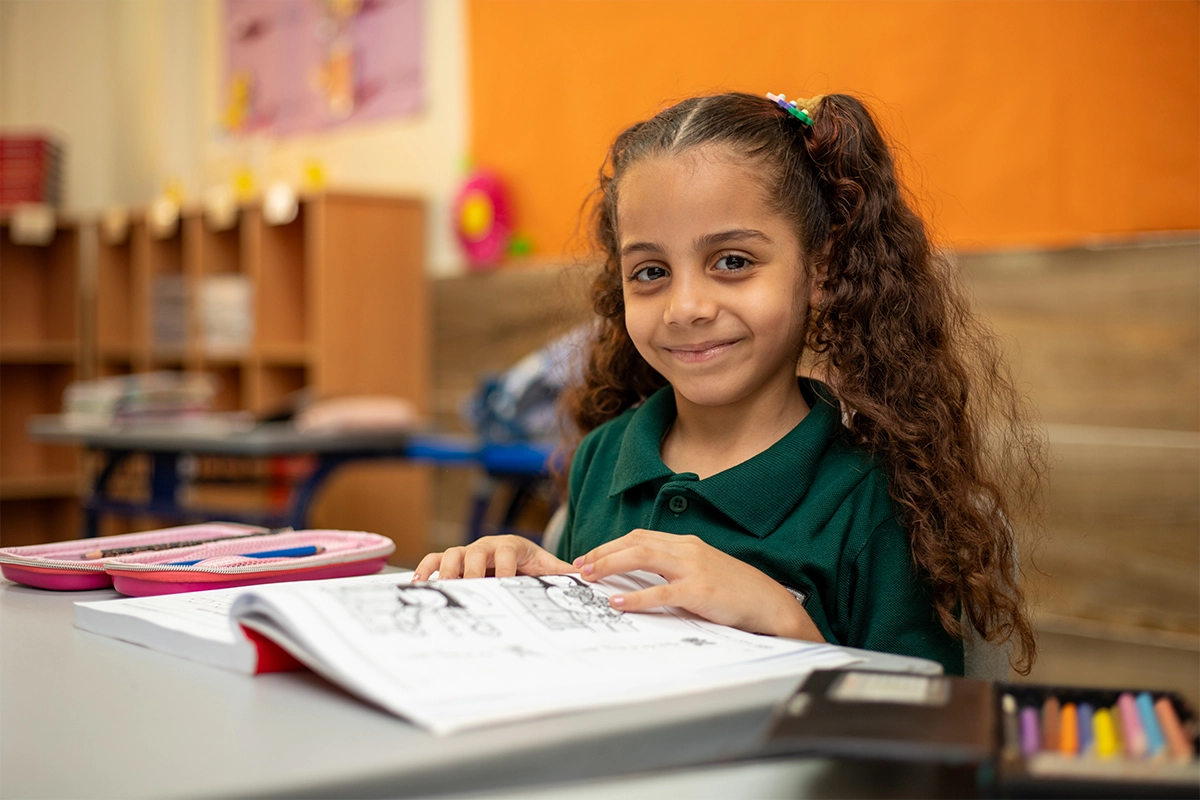
Authentic photography is not about capturing perfection; it is about capturing connection. A professional photographer understands how to document the messy, vibrant, and deeply human reality of a school day:
- The genuine spark of realization in a student's eye when they solve a complex math problem.
- The specific architectural scale of your newly built indoor swimming pool, shot with proper architectural lenses to show exact proportions without distortion.
- The authentic camaraderie of the faculty during a collaborative planning session.
- The literal texture of the campus—the scuff marks on the gymnasium floor, the paint on a kindergarten art smock.
These imperfections are not flaws; they are proof of life. They signal to the parent that your institution is a thriving ecosystem, not a sterile simulation.
When we developed the visual architecture for SCIS, the focus was heavily anchored in reality. The brand's weight comes from its tangible presence. We relied on capturing the actual environment, ensuring that the visual identity scaled perfectly across digital platforms and massive physical environmental branding, all rooted in the truth of the campus.

Where AI Excels: Design, Concept, and Abstract Aesthetics
If AI should not be used to fake reality, does it have a place in school marketing? Absolutely. When wielded correctly, AI is one of the most powerful tools for brand elevation and web design.
While photography handles the documentation, AI handles the imagination. Here is how leading schools are successfully integrating AI visuals into their marketing stacks:
1. Abstract Web Elements and Thematic Backgrounds
Modern school websites require heavy visual elements that do not necessarily need to be literal. Think of the sweeping, abstract geometric patterns used in the background of your "Core Values" page, or a stunning, stylized conceptual rendering of "The Future of Technology" for your robotics curriculum page.
AI is brilliant at generating bespoke, high-resolution textures, abstract light leaks, and thematic background art that perfectly matches a school's specific color palette. This elevates the web design from feeling like a basic template to a highly customized, premium digital experience.
2. Rapid Brand Prototyping and Storyboarding
Before a school commits to a massive rebranding initiative or a costly video commercial shoot, AI acts as the ultimate storyboard artist.
During the conceptual phase of a project, we can use AI to generate mood boards, prototype how a new logo might look embossed on a leather admissions folder, or visualize the lighting setup for an upcoming campus photoshoot. It bridges the communication gap between the marketing board and the creative team, ensuring everyone shares the same vision before a single shutter clicks.
3. Visualizing the Unbuilt (Architectural Pre-Visualization)
If your school is expanding its campus or building a new performing arts center, you need to drive enrollment *before* the concrete is poured. While traditional 3D rendering takes weeks and thousands of dollars, AI can assist in rapidly generating highly stylized concept art of future facilities based on architectural blueprints, helping parents visualize the institution's growth trajectory.
The Technical Synthesis: Building a Modern Web Architecture
The true magic happens when you combine authentic photography with AI-enhanced design elements within a flawless digital architecture. However, managing this mix of heavy visual media requires advanced web development.
A common failure point for Egyptian educational websites is performance degradation. When a school tries to upload dozens of high-resolution campus photos alongside heavy, AI-generated graphic backgrounds, the website crashes on mobile devices or takes agonizingly long to load.
To strike the right balance, the delivery mechanism must be perfectly engineered:
Optimized Delivery via Next-Gen Frameworks
Whether it is a beautifully lit shot of the library or an AI-generated abstract hero background, every asset must be aggressively optimized. Utilizing next-generation image formats (like WebP) and implementing touch-friendly, hardware-accelerated sliders (such as Swiper.js) ensures that the parent can swipe through a 50-image gallery of your sports day instantly, without a stutter.
Light and Dark Theme Compatibility
A highly sophisticated brand identity must adapt to the user's digital environment. Both your authentic photography and your graphical AI elements need to be placed within a UI that supports seamless Light and Dark mode transitions. If an AI-generated graphical asset has a harsh white background that breaks the immersion of a user browsing your site in dark mode at 10 PM, the premium feel is compromised.
Flawless Bilingual (RTL) Integration
In the Egyptian market, international schools must cater to both English-speaking expatriates and Arabic-speaking locals. This requires robust Right-to-Left (RTL) web architecture. The composition of your photography and the layout of your conceptual graphics must make sense whether the user is reading from left to right, or right to left.
We successfully navigated this precise intersection of visual identity and technical architecture during the Maven International School visual identity project. The objective was to translate their educational quality into a clear, credible presence. This wasn't just about taking nice photos; it was about ensuring those authentic visuals were framed by a modern, responsive, and technically flawless brand system.

Policy and Transparency in the AI Era
As AI becomes deeply integrated into Adobe Photoshop and other standard marketing tools, the line between an "edited photo" and an "AI-generated image" is blurring.
Schools must establish clear internal guidelines regarding visual manipulation:
- Acceptable AI Use: Using AI to extend the sky in a photograph to fit a vertical Instagram format, or removing a distracting piece of trash from the background of a campus shot.
- Unacceptable AI Use: Using AI to generate non-existent students, altering the physical layout of a classroom to make it look larger, or generating fake academic awards.
Transparency is a powerful marketing tool. A brand that is confident in its reality does not need to manufacture its core assets.
The Cost of Cutting Corners
It is tempting for a school board to look at the budget for a comprehensive, multi-day professional photoshoot and wonder if a $30-a-month AI subscription could replace it.
This is a profound misunderstanding of what a parent is buying.
A parent is not buying a pretty picture. They are buying peace of mind. They are buying the specific reality of your campus, your teachers, and your community.
When you invest in authentic, high-end photography, you are not just documenting a building; you are building an archive of institutional credibility. You are proving that your school is exactly as magnificent in reality as it claims to be on paper.
If you try to shortcut this process with artificial generation, you might save a fraction of your marketing budget in the short term, but you will erode the foundational trust required to sustain premium enrollment figures in the long term.
Conclusion: The Synergy of Concept and Reality
The future of educational marketing in Egypt does not belong to the schools that reject AI entirely, nor does it belong to the schools that rely on it exclusively to fake their reality.
The schools that will dominate their districts are those that understand how to orchestrate both.
They will use AI to push the boundaries of their digital design, to rapidly prototype brilliant branding campaigns, and to create a web presence that feels futuristic and premium. But at the core of that beautiful digital frame, the content itself—the students, the faculty, the facilities, the emotion—will be grounded in undeniable, beautifully captured photographic truth.
Manufacture the design. Document the reality.
AI can show parents what education *could* look like.
Authentic photography proves what your education *actually* is.
In a market built on trust, reality always wins.